Thursday, March 30, 2017

Bernie Sanders (Unwittingly) Makes the Case AGAINST Renewable Energy

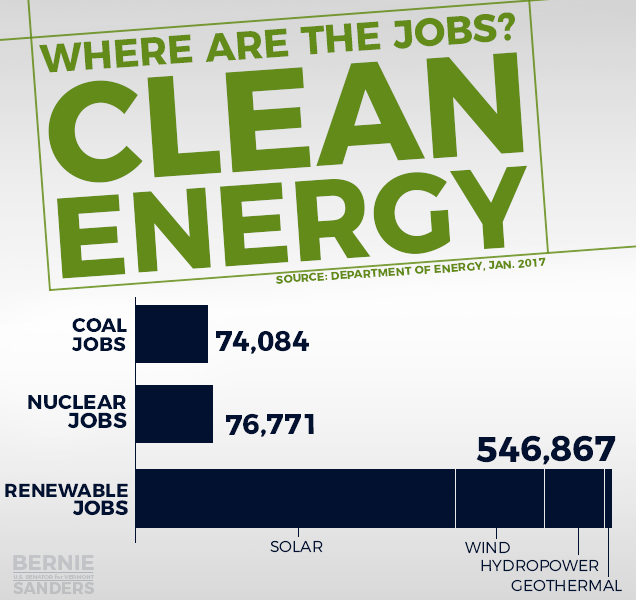
This from Bernie Sanders' Facebook page (hat tip to John Murphy for saving me the embarrassment of going there).

17554250_10155773500722908_2651558576029338235_n

Poor Bernie. He's just made the case against renewable energy.

The average worker in coal produces 2.1e^11 BTU.  The average nuclear worker produces 1.1e^11 BTU.  The average renewable worker produces 1.8e^10 BTU.  That means the average coal worker is 1033.92% more efficient than the average renewable worker!   We’d need to put in approximately 10x the number of labor resources into renewables as coal to get the exact same results!

And, Bernie, think of all the jobs there would be if all our electricity were generated by people on those generator bicycles!

Save this for the next time (which will probably be later today) you think there is some wacky thinking coming out of the White House. It could have been worse.

Wednesday, March 29, 2017

Obamacare Will Implode Sooner Rather Than Later

The deadline for insurance companies filing for the 2018 Obamacare exchanges is June 22nd. Several large insurers, including UnitedHealth and Aetna have already decided to cut their losses. Once the Trump administration stops subsidies to the insurance companies, more will drop out and those that decide to stay will need to file large premium increases.  At that point, what do Democrats do? This is their creation. They can work with Republicans to produce something acceptable to both. Or they can continue to hold back votes in hopes that . . . what? Republicans will authorize new massive subsidies to insurers?


Monday, March 27, 2017

A Protectionist Fable

A farmer in rural Iowa says to his wife, "My love: I will take our corn to market, and from the proceeds I will buy our daughter a dress!"  So, he loads up his truck with his corn (which was grown with the sweat of his brow) and takes it to Iowa City.  He enters the market and a Frenchman says:
"Sir!  How fine it is to see you!  I have just what you are looking for.  I have this collection of fine dresses from Paris.  If you give me your corn, I can sell you four dresses for your lovely daughter."
A Bostonian then approaches the farmer and says: "I will give you two dresses for your corn."
The farmer considers both offers and decides to deal with the Frenchman.
"Wait!" says the custom officer.  "Do not buy those four dresses from Europe.  My orders are to keep you from buying French goods.  Rather, for the same price, you can buy these two dresses from Boston.  You, and our nation, will be better for it.  Surely you can see America will be worse off if you get the four dresses rather than the two."
"Two dresses for the same price as the four?  How will such a deal make me wealthier?"
"Oh, I can't answer that question!" says the customs official.  "But it is a fact;  for all our secretaries and department heads and legislators and journalists agree that the more a nation receives for its goods, the poorer it becomes."
And so the farmer deals with the Bostonian, but he (and everyone else) is left wondering why a person is ruined receiving four dresses instead of two
(Thanks to John Murphy)

Thursday, March 23, 2017

Our Idiotic Tax Payment System

Joe Bankman, a law professor at Stanford, explains the "logic" of our income tax.

"Imagine if you had to pay your credit card bill the way you pay your taxes. 
Each month, Visa would send you a blank form. The form would instruct you to gather all your receipts, write down every purchase you had made, and calculate the total amount you owed Visa. 
After you sent in your bill, Visa would check its records. If you’d forgotten a receipt and underpaid, Visa would fine you. If you’d made a big enough mistake, you’d go to jail."

I would just add that in this example the cost of paying your Visa bill this way would be about 20 cents per dollar of purchases.

The United States is the only wealthy country in the world that forces its taxpayers to gather up tax forms and calculate their own bill. It exists because the tax compliance industry and government both benefit from the system. At your expense.

Friday, March 17, 2017

Third Party Payments are Why Healthcare Costs Are So High

Mark Perry at AEI posts this chart showing how little of health care costs are now paid for by the people receiving the service. Is it any wonder that prices would be rising rapidly when we have almost totally removed incentives for consumers to monitor prices and control usage.

What do you think would happen to the cost of food if people only paid directly for 10% of the cost of what they ate?

Thursday, March 16, 2017

The Economics of Wall Building

The National Academies of Sciences, Engineering and Medicine (NAS) estimates that the average cost to taxpayers of an illegal immigrant is $75,000  --  taking into account taxes paid and the cost of providing benefits such as education and health care. The estimated cost of completing the Southern border wall is around $20 Billion. Mathematically that means that if the wall prevents only 260,000 illegals from entering the country it will have a positive ROI.

Since Trump was elected, the number of illegal border crossings has dropped significantly (some estimates suggest a 50% reduction) just in response to the threat of building the wall and stricter enforcement of existing immigration law.  It seems rather likely that The Wall could be one of those rare government expenditures with a positive return on the investment.

Wednesday, March 15, 2017

Obvious and Non-Obvious Facts About GOP Health Plan

First the obvious. If you listen to the headlines (and don't dig through the facts) you're probably under the impression that the GOP alternative to Obamacare would result in millions of people being left "uncovered" by a health plan (the CBO estimates 14 million). Why is that? It's because 14 million people who are currently forced by law to buy a health plan, will no longer buy one when they are given a choice. If you were forced to participate in your employer's retirement plan and the employer then gave you the option to opt out, would you complain that those who made that choice were "left uncovered by the employer"? This should be obvious, so I have to presume the media is not pointing this out with malice aforethought.

But there is a less obvious issue. The GOP plan results in almost $900 Billion in tax and spending savings. Now let's presume for a moment (against all historical experience) that the CBO estimate of 14 million fewer people opting for insurance is accurate. That implies that there are savings of over $60,000 per person left "uncovered" as a result of this change. Do you think we could buy a basic healthcare insurance plan to these people for less than $60,000 in premiums? This highlights not only the inefficiency of Obamacare, but also the fact that the purpose of Obamacare was never to economically provide health insurance to the uninsured. It was to give government a toehold toward taking over the entire industry. Even if the cost of doing so is catastrophically high. Even if people have to lose their doctor and pay higher premiums. To a progressive, that's just collateral damage.

Tuesday, March 7, 2017

Asian Privilege

From AEI and the College Board, here are the trends in SAT reading scores over the last 20 years. Clearly Asian Privilege must be involved.

Wednesday, March 1, 2017

Philly Soda Tax Fizzles -- Just as You'd Expect

From the Washington Tines:

A newly imposed tax on sugary drinks sold within Philadelphia likely earned a fraction of the revenue its advocates had expected, city officials said Tuesday.
Philly had hoped that the 1.5 cent-per-ounce tax on sodas and other sweetened drinks would reap about $7.6 million each month for City Hall upon taking effect Jan. 1. According to preliminary data, however, the levy earned the city a measly $2.3 million during its first month on the books, or only 30 percent of what was expected, local media reported Tuesday.
Grocery stores and wholesalers alike now say they’re weighing potential layoffs to make up for lost profits attributed on the excise.
“People didn’t change what they drink,” the CEO of Brown’s Super Stores told the Philadelphia Inquirer. “They changed where they’re buying it.”
Jeff Brown, the owner of six ShopRite grocery stores within city limits, said beverage sales slipped 50 percent from Jan. 1 to Feb. 17 over the previous year’s figures, and cited a 15 percent overall dip in sales at city stores. As a result, according to Mr. Brown, he’s already eliminated about 280 jobs and is eyeing additional layoffs in the coming months.

This lesson, of course will not get to the Seattle City Council, which has proposed leaping off the same bridge. Nor will the Council stop to think about what a tax on labor (aka the $15 minimum wage) is doing to demand for labor in the City of Seattle. Nope. Seattle will continue to be a Sanctuary City for the Economically Ignorant.

Friday, February 10, 2017

The 180 on Parental Choice By Senator Warren

About ten years ago I read a very well done book by, then Harvard Law professor Elizabeth Warren entitled The Two-Income Trap: Why Middle-Class Parents Are (Still) Going Broke” (2003) by Elizabeth Warren and Amelia Warren Tyagi.


Below is an excerpt from that book which makes a great deal of sense. Unfortunately, since the time she wrote it, now Senator Warren has discovered the money train provided by the teacher's unions. As a result she has completely reversed her opinion of parental choice in schools. There are only two possibilities here:

1. Being elected to office removes rational thinking from your skill set.
2. Senator Warren (who once claimed to have American Indian heritage in order to enhance her employment possibilities) has always been a hypocrite.

Not sure which is the more flattering choice.


Any policy that loosens the ironclad relationship between location-location-location and school-school-school would eliminate the need for parents to pay an inflated price for a home just because it happens to lie within the boundaries of a desirable school district.
A well-designed voucher program would fit the bill neatly. A taxpayer-funded voucher that paid the entire cost of educating a child (not just a partial subsidy) would open a range of opportunities to all children. . . . Fully funded vouchers would relieve parents from the terrible choice of leaving their kids in lousy schools or bankrupting themselves to escape those schools.
We recognize that the term “voucher” has become a dirty word in many educational circles. The reason is straightforward: The current debate over vouchers is framed as a public-versus-private rift, with vouchers denounced for draining off much-needed funds from public schools. The fear is that partial-subsidy vouchers provide a boost so that better-off parents can opt out of a failing public school system, while the other children are left behind.
But the public-versus-private competition misses the central point. The problem is not vouchers; the problem is parental choice. Under current voucher schemes, children who do not use the vouchers are still assigned to public schools based on their zip codes. This means that in the overwhelming majority of cases, a bureaucrat picks the child’s school, not a parent. The only way for parents to exercise any choice is to buy a different home—which is exactly how the bidding wars started.
Short of buying a new home, parents currently have only one way to escape a failing public school: Send the kids to private school. But there is another alternative, one that would keep much-needed tax dollars inside the public school system while still reaping the advantages offered by a voucher program. Local governments could enact meaningful reform by enabling parents to choose from among all the public schools in a locale, with no presumptive assignment based on neighborhood. Under a public school voucher program, parents, not bureaucrats, would have the power to pick schools for their children—and to choose which schools would get their children’s vouchers.

Monday, February 6, 2017

Median HH Income is Stagnant, but NOT for the Reasons You've Been Told

Mark Perry  at U of Michigan created this very interesting chart. Yes, median household income has not been growing for the last 15 years. You've heard that. But real hourly compensation has been growing steadily. Mathematically this can only happen if the median number of hours worked per household fell. There are several possibilities which would contribute to this:

1. Employed people are working fewer hours. We know that Obamacare caused many jobs to become part-time rather than full time. People may also be voluntarily reducing

2. There are fewer people employed per household. We know that household size has been steadily decreasing for some time. If a working couple divorces, the number of hours worked per household (now 2 instead of 1) drops as does the medium income per household.

3. The percent of the workforce that is employed continues to drop year after year. That results in fewer hours worked per household.

The bottom line is that when the media and politicians shout that the "median household income is falling" it is not because people are being paid less to work. There is just a lot less work being done in the average household.


Sunday, January 22, 2017

The Answer to Failing Schools is More Money?

According to the most recent report from the National Center for Education Statistics, the amount of money (in real dollars) spent on educating K-12 students is almost 4 times today what it was 50 years ago.  Yet the quality of education has not improved and by many measures has declined. What are the odds that the remedy for this is spending even more money on the same education?  If your Ford dealer told you that the best solution for a car that didn't run well was to spend ever more money on it, would you? Or would you perhaps try something different? And how would you feel if government told you that if you did try something else, you'd have to keep paying ever more money to that Ford dealer?


Total and current expenditures* per pupil in public elementary and secondary schools

1920          $  598
1930            1251
1940            1562
1950            2325
1960            3568
1970            5546
1980            7027
1990            9705
2000          11302
2014          12509

*Constant 2015-16 Dollars

Friday, January 20, 2017

Oxfam Blames the Wealthy for Poverty

Oxfam (a UK based charity whose mission is "fight poverty") recently sent out this appeal (see below) in which they imply that poverty is caused by businessmen who are wildly successful. They are repeating the falsehood that wealth is a zero sum game -- that the less successful would be wealthier if, somehow , the really successful were less so.

The fact of the matter is that the number of people who are desperately poor (living on $1/day) has been declining steadily and significantly over the last fifty years -- i.e. the time frame over which all the wealthy people whom Oxfam disparages accumulated their wealth. The poor have become less poor precisely because of that wealth creation. Bill Gates wealth via Microsoft is not the reason the poor are poor; it is why they are less poor. Mr. Gates did far more for the world's poor by making Microsoft a success than he will ever do with his foundation (and the two are non mutually exclusive).

Oxfam's sloppy thinking (I'm being generous here) is deplorable.

Image result for poverty levels declining worldwide chart


Oxfam America
Facebook
Twitter
Donate
January Newsletter


Gift a cow

Have you seen the news this week that just 8 men own as much wealth as the poorest half of the world's population? This news comes after the release of our new report "An economy for the 99%".
Here at home and across the world, millions of ordinary people have been left behind by an economy for the 1%. We must take urgent action to reverse dangerous inequality – not accelerate it.
The poorest people in our societies have been hit hardest – particularly women who suffer high levels of economic discrimination, work in the lowest paid jobs, and take on the lion's share of unpaid care work.
Read more about staggering inequality and how you can take action >>

Tuesday, January 10, 2017

The Real World (not Obama's World) Will Continue to Run on Fossil Fuels

While President Obama was sitting in his office contemplating Utopian worlds powered by wind and solar power, his Energy Department was contemplating the real world in their Annual Energy Outlook Report.

energysources

Saturday, January 7, 2017

Global Warming Data for the Rest of Us

I realize that the case for Global Warming is based on "complex models" that nobody but the most sophisticated climatologists can understand, but . . .


don't you think the above chart makes it a little harder to join the "question is settled" crowd? Don't you think that the news media getting excited over one of these oscillating spikes is a bit naïve? As a statistician, this data looks pretty random around a zero mean to me.

Thursday, January 5, 2017

Minimum Wage Insanity

I eat often at a breakfast spot in Arizona I like very much. They employ about ten people. Most of them make minimum wage (plus tips).  This year they may face an increased cost of close to $40,000 in their labor costs. I doubt if this restaurant clears more than $100,000 in net profit. What do you think they will do in the face of a 25% increase in labor costs? How do the people who impose these costs by legislation expect small businesses to manage? This is pure insanity.

minwage1

Monday, January 2, 2017

The Economically Innumerate in Government

In 2010, the New York legislature raised cigarette taxes to $4.35 per pack, the highest in the nation. It did this, it said, to raise more revenue for the state. Since that time revenue from cigarette taxes has plunged by $400 million. Organized crime is happy, though, as smuggling now accounts for nearly 60% of the cigarettes sold in New York. Anyone smart enough to review the history of prohibition in New York could have predicted this. Apparently you don't have to be very smart to be in the New York legislature.

When I lived in Chicago in the early 1970s, the city council banned detergents containing phosphates. Now what do you think happened? Sales of Tide and other phosphated detergents boomed in the suburbs around Chicago and nobody bought the phosphate-free detergents left on Chicago store shelves (maybe because they didn't clean very well).  The City Council of Chicago said they took this action to reduce Lake Michigan pollution from sewage in the Chicago Sanitary Canal. Since the canal actually flows out of Lake Michigan, not into it, I guess you don't even have to be as smart as a New York legislator to be on the Chicago City Council. 

Comparing Purchasing Power by State

What a dollar buys in Omaha is more than what a dollar buys in New York. And what a Euro buys in Athens isn't the same as what $1.08 (currency exchanged) buys in Omaha either. Thus the adjustment of Purchasing Power Parity. PPP adjusts for these factors and really tries to compare apples to apples, or at least what it takes to buy an apple somewhere.

With that in mind here is a select table of GDP per capita on a PPP basis for 2014.

North Dakota                             $72,719
Wyoming                                     69,993
Massachusetts                              67,515
California                                     58 901
Texas                                            58,748
Ohio                                              49,049
Missouri                                        45,721
Sweden                                          45,183
West Virginia                                40,003
United Kingdom                            39,762
France                                            38,847
Mississippi                                     34,784
South Korea                                   34,355
Greece                                            25,877
Mexico                                           17,107
China                                              13,206

One of the obvious takeaways is that even the poorest of the United States (Mississippi) is almost as wealthy as Sweden, and considerably more so than Mexico or China (which Donald Trump says are "beating us").


The Life Expectancy Myth

It ain't what you don't know that gets you into trouble. It's what you know for sure that just ain't so.  --- Mark Twain

One of the most often cited reasons in support of socialized healthcare is the fact that the United States spends more per person on medical care than any other nation, yet our life expectancies are lower.

That statement is actually true. However, as Robert Ohsfeldt pointed out in his book The Business of Health, the reason it is true is because Americans have a very disproportionate tendency to kill themselves. If you exclude homicides and auto accidents from the data, US life expectancy is #1 in the world. While our health care system is doing a poor job of preventing shootouts and drunk driving, it is doing a good job of healing the sick.

One of the exercises we had in my first economics class was to write a paper using statistics to "prove" something that was demonstrably false. It tuned out to be an easy assignment (I think I proved that church attendance caused crime rates to increase). In this case, it turns out (not all that surprisingly) that there are many things that affect mortality besides health care. Always look behind the statistics.

Sunday, January 1, 2017

Why Government Productivity is Always Less Than the Private Sector

Want to understand why government productivity is inevitably much worse than the private sector?

Imagine there are two companies. Lets call them Alpha and Beta.

At Alpha, employees get reviewed frequently and are rewarded with raises if they meet their goals. Those that don't meet their goals for many quarters are fired and replaced with new employees. The company's motto is: Adequate is Not Good Enough.

At Beta, performance reviews have few consequences. Employees don't get raises for meeting goals, but rather for years of employment with the company. Employees who fail to meet goals are allowed to stay with the company as long as they want to. The company's motto is: Adequate Is Good Enough. 

What would you expect to happen?  Beta employees who are ambitious and can meet goals realize they can make more money working at Alpha. Alpha employees who can't or don't want to meet their goals get fired or quit and go to work at Beta.  Over time, what happens? Alpha ends up with more of the better performers, Beta ends up with fewer.

Now if Alpha and Beta are both in competitive industries, Alpha does well and grows; Beta shrinks and eventually goes out of business. But what if Beta has no competition? What if they can literally force their shareholders to give them money to stay afloat? They just keep getting worse and bigger.

It's just that way with the public sector and the private sector. The private sector attracts more of the ambitious goal-oriented employees; the government attracts the less ambitious people who seek employment security over accomplishment. Neither will ever be made up entirely of one type or the other, but the skews will be in opposite directions.

Economics 101: That which you reward you will get more of. That which you penalize you will get less of.