Edmund Phelps. Nobel Laureate in economics, debunks the Keynesian notion that "fiscal stimulus" helps economies recover form recessions. If that were the case, countries that had larger debt (stimulus) would have recovered faster than those that implemented dreaded "austerity" budgets such as Spain, Portugal and France. Big deficits did not speed up recoveries. In fact, the relationship is
negative, suggesting fiscal profligacy led to contraction and fiscal
responsibility would have been better.
Yet, the next time we have a recession, count on the willfully ignorant in government and the media to call for more "stimulus".
Tuesday, October 30, 2018
Thursday, October 25, 2018
60% of Households Receive More in Government Transfers than they Pay in Taxes
According to a report released
this year by the Congressional Budget Office, only the top two income
quintiles in the United States pay more in taxes than they receive in
government transfers. Fair share?
Friday, October 5, 2018
Factory Jobs Are NOT Coming Back, Mr. President
Those who think Donald Trump (or anyone else) is going to "bring back factory jobs" to America needs to study this chart for a moment. I'm pretty sure The Chinese were not responsible for the declines prior to 1980. Nor those after 1980, for that matter.
Wednesday, September 19, 2018
How Socialism Destroys -- in One Chart
In this one chart from Mark Perry we see the power of capitalism to create economic activity and power of socialism to destroy it.
Sunday, September 16, 2018
Income Inequality is Something You Control
Mark Perry at U of Michigan created this summary chart about income distribution for those who think income inequality is something that is externally foist upon us. It pretty clearly demonstrates that:
1. The more people you have working in your household, the higher will be your HH income
2. If you want higher income, get married
3. The highest income households are those with people in peak earning years (35-64). In other words, people just starting out or those who are retired earn less than a 50 year old with a 30 year work history.
4. If you want to earn more money, don't drop out of high school. Earn an advanced degree.
While these points may seem obvious, they don't seem to penetrate the skulls of those in the media who decry "income inequality" as if it is a disease that randomly attacks people. If you don't like being in the bottom quintiles of income you CAN do something about it -- e.g. get married, get a job, finish high school, GROW UP (literally and figuratively).
1. The more people you have working in your household, the higher will be your HH income
2. If you want higher income, get married
3. The highest income households are those with people in peak earning years (35-64). In other words, people just starting out or those who are retired earn less than a 50 year old with a 30 year work history.
4. If you want to earn more money, don't drop out of high school. Earn an advanced degree.
While these points may seem obvious, they don't seem to penetrate the skulls of those in the media who decry "income inequality" as if it is a disease that randomly attacks people. If you don't like being in the bottom quintiles of income you CAN do something about it -- e.g. get married, get a job, finish high school, GROW UP (literally and figuratively).
Sunday, September 9, 2018
Growth, Not Obama Fuels the Labor Force
A reminder. Only one thing affected the decline in labor participation -- economic growth. Economic growth fueled by actions that increase corporate profits and hence the need to hire more people. For all of President Obama's preening this week, it should be quite clear from these charts what happened during his eight years in office.
Tuesday, July 24, 2018
The Diversity Blob Just Keeps Growing
Ever wake up one day to see a sprawling bureaucracy and wonder how it got there? Below are the employees who work in the "Diversity Department" at the University of Michigan. It's almost 11 million dollars in payroll. How many scholarships could Michigan provide for $11MM? This is just one university in the country. Now you know where all the people with degrees in woman's studies, black studies and queer studies go to "work". If you live in Michigan, your tax dollars go to support this blob. And you can bet there's a similar bureaucracy at every public university.
My favorite is the web designer who "earns" almost $100K. Every hire a web designer? They typically work for less than half that. But they're probably not "diverse" enough. This one is no doubt special.
Monday, June 18, 2018
Yes, Girls Outperform Boys
The NY Times took the data below and decided that it was a big story. And it is. Now you might think the obvious conclusion from this data was: Girls consistently outperform boys in English skills. That is a big story. But the Times decided the story was:
Boys Outperform Girls in Math:
Yes. Ignoring the most important aspect of the report, they chose to make this a story about . . . wait for it . . . White Privilege. White Privilege doesn’t appear to affect English skills, only math skills. The Times doesn’t really explain that, but, damn, those rich white kids sure do get math better. And isn’t that unfair?
Boys Outperform Girls in Math:
Rich, White and Suburban Districts
Yes. Ignoring the most important aspect of the report, they chose to make this a story about . . . wait for it . . . White Privilege. White Privilege doesn’t appear to affect English skills, only math skills. The Times doesn’t really explain that, but, damn, those rich white kids sure do get math better. And isn’t that unfair?
Thursday, May 17, 2018
Yes The Middle Class is Shrinking, But Why is That Bad?
Yes, it's true that the percentage of households earning "middle class incomes ($50-100,000) is declining. But it's declining because those earning more than that amount have been increasing so rapidly. If you listen to politicians and the media they seem to think that's something to be alarmed about. Why?
Monday, May 7, 2018
The Rich Pay Everyone's Taxes
The Rich don't pay their fair share share of taxes. They pay everyone's taxes.
Chart courtesy of Mark Perry
Thursday, April 19, 2018
The Short Term effects of Minimum Wage Increases
This will not come as a shock to anyone who has successfully completed Economics 101, but two professors from University of California San Diego felt it necessary to publish a paper that shows that labor has a demand curve as well. From their abstract:
As of 2015, We estimate that relatively
large minimum wage increases(defined as those exceeding $1) reduced employment
among low-skilled population groups by just over 1 percentage point.
Monday, April 16, 2018
What Do Universities Plan to Do About This Gender Disparity?
Progressives claim there are no inherent differences between genders. Ergo any male-female disparities must be explained by discrimination of some sort, which requires remediation. So my questions are this:
1. In light of the disparity in college degrees, what is it that colleges and universities are doing that discriminate in favor women over men?
2. Universities have been particularly active in doing things to narrow gender disparities. What do they plan to do about this one? Safe spaces for men? Extra points on exams for men? More tuition assistance for men and less for women? Inquiring minds want to know.
1. In light of the disparity in college degrees, what is it that colleges and universities are doing that discriminate in favor women over men?
2. Universities have been particularly active in doing things to narrow gender disparities. What do they plan to do about this one? Safe spaces for men? Extra points on exams for men? More tuition assistance for men and less for women? Inquiring minds want to know.
Tuesday, April 10, 2018
The Myth of Tax Cuts for the Rich
If you listen to Democrats in Congress and most of the media you'd probably think the recent tax legislation were "tax cuts of the rich". If you used facts instead of rhetoric, you'd know that isn't true.
The tax cuts will result in the highest earning Americans actually shouldering more of the income tax burden than in 2017. If your household earns $150,000 (which doesn't exactly make you "rich" in most major urban centers), you get the privilege of helping to pay 87% of the country's income taxes. Middle income households in contrast will pay 4%.
Wednesday, March 28, 2018
More Evidence of the Perverse Effects of the Minimum Wage
A new study from Grace Lordan, London School of Economics and David Neumark, University of California at Irvine shows the following:
1. Increasing the minimum wage decreases significantly the share of automatable employment held by low-skilled workers.
2. An increase of the minimum wage by $1 (based on 2015 dollars) decreases the share of low-skilled automatable jobs by 0.43 percentage point.
1. Increasing the minimum wage decreases significantly the share of automatable employment held by low-skilled workers.
2. An increase of the minimum wage by $1 (based on 2015 dollars) decreases the share of low-skilled automatable jobs by 0.43 percentage point.
Tuesday, March 13, 2018
The Balance of Payments Must Always Balance
Apparently Donald Trump didn't study Balance of Payments at Wharton because he is always wailing about a "trade deficit". A trade deficit is always balanced by a surplus of foreign investment.
So, for example, if US businesses and consumers import more than they export, there is a corresponding increase in the capital investment from abroad -- e.g. buying the stocks and bonds of US companies, investing in US treasury debt. Why this would be bad is beyond me.
Tuesday, February 27, 2018
More on Cost-Benefit in Education
Here's another example where the education establishment ignores cost-benefit analysis.
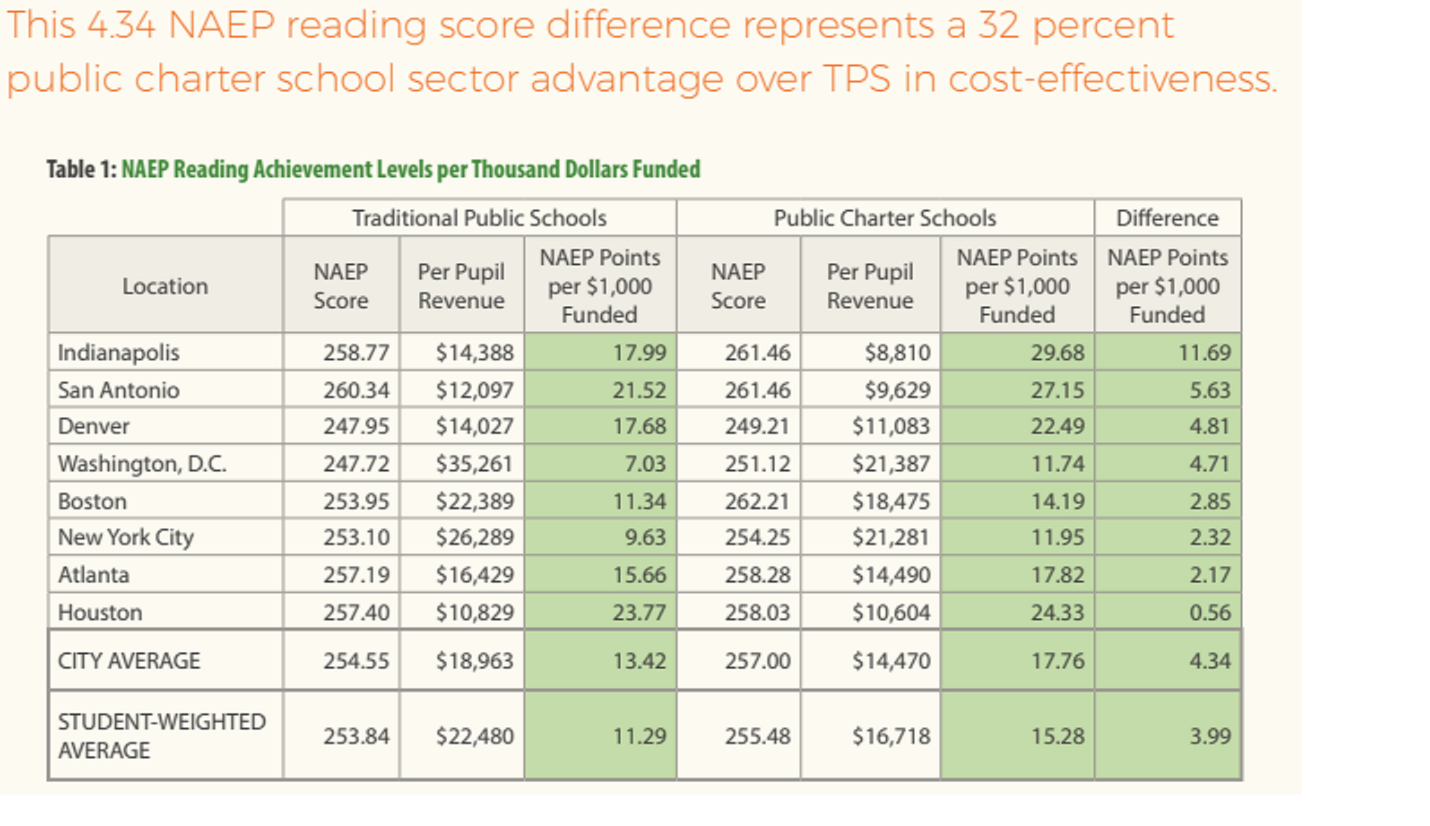
A new study from CATO and the University of Arkansas examines student performance at charter schools and traditional schools in eight major U.S. cities, Washington D.C., Indianapolis, Boston, Denver, San Antonio, New York City, Atlanta, and Houston. These researchers also conducted a return-on-investment (ROI) analysis, comparing projected lifetime earnings of charter school students with those of traditional school students, relative to the cost to taxpayers. Their conclusion? They show public charter schools are delivering better results for students at significantly lower costs to taxpayers.
Yet the education establishment routinely opposes charter schools. Not surprising if your objective has more to do with employing people than educating students.

A new study from CATO and the University of Arkansas examines student performance at charter schools and traditional schools in eight major U.S. cities, Washington D.C., Indianapolis, Boston, Denver, San Antonio, New York City, Atlanta, and Houston. These researchers also conducted a return-on-investment (ROI) analysis, comparing projected lifetime earnings of charter school students with those of traditional school students, relative to the cost to taxpayers. Their conclusion? They show public charter schools are delivering better results for students at significantly lower costs to taxpayers.
Yet the education establishment routinely opposes charter schools. Not surprising if your objective has more to do with employing people than educating students.

Monday, February 26, 2018
Education is Exempted From Cost-Benefit Analysis
Most people grasp the idea of cost-benefit analysis. for instance, you wouldn't spend $100,000 on improvements to your home if it added only $10,000 to the selling price. And you wouldn't spend a million dollars on advertising your business if it only increased sales by $100,000.
However, when it comes to education, people seem to be living in a different universe. They are spending huge amounts of money and getting no benefit from it. If your local supermarket doubled your grocery bill so they could hire more people, but gave you the same amount of food at the same service level, would you continue to do business with them? Of course not. What if government forced you to pay that store even if you went elsewhere to shop? They would have no incentive to stop spending money for no benefit, would they?
Monday, February 19, 2018
International Trade=Lower Prices
Questions for today.
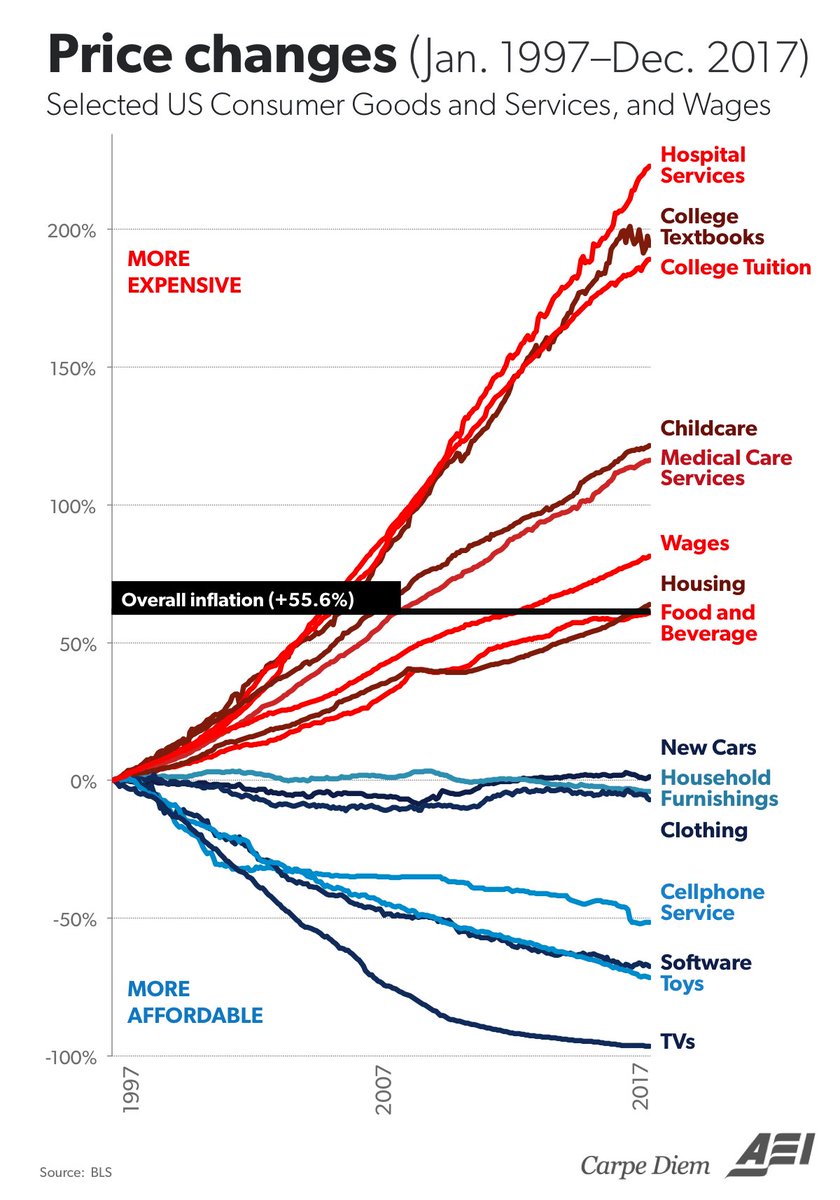
1. Do you think it's a coincidence that the categories with the lowest price changes are the ones that are traded internationally?
2. Do you think it's a coincidence that the categories with the highest rate of price change are the ones with the most regulation and government subsidy?
3. What do you think will happen if we adopt more protectionist policies?

1. Do you think it's a coincidence that the categories with the lowest price changes are the ones that are traded internationally?
2. Do you think it's a coincidence that the categories with the highest rate of price change are the ones with the most regulation and government subsidy?
3. What do you think will happen if we adopt more protectionist policies?

Thursday, February 15, 2018
Monday, February 5, 2018
Watching the Stock Market Work
Over the last 14 months, we have had a compressed demonstration of how the stock market works. At any given point in time, the intrinsic value of equity investments roughly reflects two factors.
When Donald Trump was elected President the expectations of future earnings rose dramatically because he promised, then delivered on, reduced taxes and government regulation. Both of these actions greatly increased expectations of future corporate earnings versus what they had been under the Obama administration and what could be expected from another Clinton administration. Hence the significant market run-up immediately following his election.
The second factor we've seen play out in the last week. The Federal Reserve has made it pretty clear that we can expect higher interest rates in the future. This affects expectations for bonds, the primary alternative to equity investments.
Traders trying to guess which of these two factors will be dominant create a lot of day-to-day volatility, but over the longer run, it is the battle between these two expectations that counts. If corporate earnings continue to grow faster than expected, Factor #1 will prevail. Otherwise, you can expect a major correction in 2018.
1. A discounted present value of expected future earnings.
2. The expected returns from competing investments.
When Donald Trump was elected President the expectations of future earnings rose dramatically because he promised, then delivered on, reduced taxes and government regulation. Both of these actions greatly increased expectations of future corporate earnings versus what they had been under the Obama administration and what could be expected from another Clinton administration. Hence the significant market run-up immediately following his election.
The second factor we've seen play out in the last week. The Federal Reserve has made it pretty clear that we can expect higher interest rates in the future. This affects expectations for bonds, the primary alternative to equity investments.
Traders trying to guess which of these two factors will be dominant create a lot of day-to-day volatility, but over the longer run, it is the battle between these two expectations that counts. If corporate earnings continue to grow faster than expected, Factor #1 will prevail. Otherwise, you can expect a major correction in 2018.
Subscribe to:
Posts (Atom)