
Showing posts with label Income Taxes. Show all posts
Showing posts with label Income Taxes. Show all posts
Wednesday, November 29, 2017
The Rich Are Not Paying Their Fair Share
Democrats are right. The Rich are not paying their Fair Share of income taxes. They're paying more than everyone else's share.


Friday, October 27, 2017
Fair Share of Taxes?
This chart from Professor Mark Perry.
1396 US taxpayers collectively paid far more income tax than 70 million Americans who paid the least tax.
And yet the constant drumbeat, "The Rich don't pay their fair share of taxes".
Darn right, it's not a Fair Share.
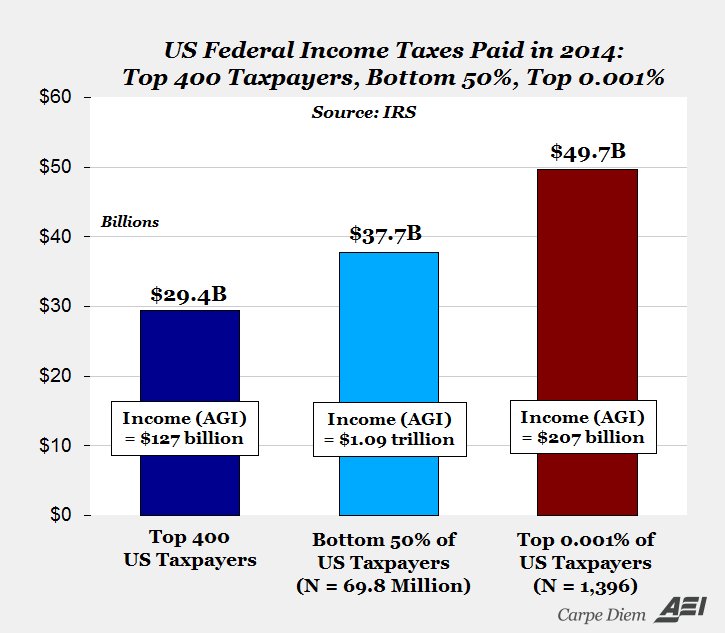
1396 US taxpayers collectively paid far more income tax than 70 million Americans who paid the least tax.
And yet the constant drumbeat, "The Rich don't pay their fair share of taxes".
Darn right, it's not a Fair Share.
Sunday, January 18, 2015
The Income Tax is More Skewed Than Ever
President Obama announced that in his State of the Union Message he would propose to raise income taxes on The Rich. This announcement came in the same week that the IRS published new data for 2012 that show that income taxes are more skewed than ever before. Now we know facts and analysis are not the President's strong suit, but wasn't there anyone on his staff who could read charts for him? Or maybe it's the same staff that told him that Obamacare would reduce healthcare costs by $2500 per year? Or (more likely) the President just doesn't care much about the truth.

Tuesday, April 15, 2014
Tax Day "Fairness" Tidbits
20% of the population pays 94% of the federal income taxes. That means for the other 80%, government programs that might increase current or future taxes have virtually no cost to them. And you wonder why they're so popular.

Over the last 30 years the federal income tax average rate has gone down for 99% of the population. The only group experiencing an increase is the reviled Top 1% .

Over the last 30 years the federal income tax average rate has gone down for 99% of the population. The only group experiencing an increase is the reviled Top 1% .
Monday, February 3, 2014
The Great Government Mutual Fund Investment Opportuntiy
Imagine there was a new mutual fund with the following proposition. We want you to take money out of your current investments and give it to us. Here's our plan. First, we're going to impose a 20% load on your investment up front, so that you will have to take $1.20 out of your current portfolio for every dollar we invest. Then, we're going to invest your money in companies and projects that have such low return prospects that ordinary investment funds refuse to fund them.
Does that sound like something you'd be anxious to do? You're probably saying, "Why, the only way they could raise money for that fund would be to threaten to put you in jail if you didn't invest!" And you'd be right.
In fact this is a good approximation of the prospectus the Federal government should publish for it's spending operations.
1. Government raises the money it spends from taxes -- mostly income taxes. Compliance costs for administering this tax are about 20% of the revenue collected. That means that effectively the government takes $1.20 out of the economy for every $1 it plans to spend.
2. While in theory, government could spend most of it's money on things that have good economic returns, in practice it doesn't. It invests in things like Solyndra and Cash for Clunkers, but mostly it sends checks out to subsidize people who aren't producing much right now.
This is the fundamental reason why government spending is not, and really cannot be economically productive (or "stimulative") -- any more than the mutual fund we've described can produce better results than the ones in which you already invest.
Does that sound like something you'd be anxious to do? You're probably saying, "Why, the only way they could raise money for that fund would be to threaten to put you in jail if you didn't invest!" And you'd be right.
In fact this is a good approximation of the prospectus the Federal government should publish for it's spending operations.
1. Government raises the money it spends from taxes -- mostly income taxes. Compliance costs for administering this tax are about 20% of the revenue collected. That means that effectively the government takes $1.20 out of the economy for every $1 it plans to spend.
2. While in theory, government could spend most of it's money on things that have good economic returns, in practice it doesn't. It invests in things like Solyndra and Cash for Clunkers, but mostly it sends checks out to subsidize people who aren't producing much right now.
This is the fundamental reason why government spending is not, and really cannot be economically productive (or "stimulative") -- any more than the mutual fund we've described can produce better results than the ones in which you already invest.
Monday, May 6, 2013
Money Talks -- And Walks
A fundamental principle of economics is that capital will always seek its highest economic return. In the investment world, this can happen pretty quickly. In the physical world it happens a bit slower, but it still happens.
The IRS says that over the last 15 years 9 states with no income tax gained $146 Billion in income from people who moved into those states. The 9 states with the highest state income taxes lost $107 Billion.

The IRS says that over the last 15 years 9 states with no income tax gained $146 Billion in income from people who moved into those states. The 9 states with the highest state income taxes lost $107 Billion.
Monday, October 1, 2012
The Impact of Taxes AND Transfers
A lot of numbers get thrown about concerning the true burden of taxation. All of them miss the impact of an extremely important factor: government transfers. Government transfers are payments like Food Stamps, Earned Income Tax Credits, Social Security and free cellphones (yes the government subsidizes phone service and everyone who gets a telecomm bill pays for it). To evaluate the effective rate of taxation, you have to take these payments into account. After all, if you earn $2, are taxed $1 and you get $2 in payments, it would be disingenuous to say you have an effective tax rate of 50%.
So how do transfers affect the picture? For the lowest income group, income after taxes and transfers is four times that of income before taxes and transfers. Only about half of income earners actually have any positive effective tax after transfers. The media is ignorant on this subject. Willfully so.

So how do transfers affect the picture? For the lowest income group, income after taxes and transfers is four times that of income before taxes and transfers. Only about half of income earners actually have any positive effective tax after transfers. The media is ignorant on this subject. Willfully so.
Subscribe to:
Posts (Atom)