Showing posts with label Minimum Wage. Show all posts

Wednesday, June 30, 2021

The Minimum Wage Does Almost Nothing for Low Wage Workers

Mark Perry points out that doubling the minimum wage does not provide much net financial benefit to low wage earners. 


Sunday, June 13, 2021

Minimum Wage = Lower Total Compensation

 This study published in the Harvard Business Review by three economists demonstrates that when companies are forced to pay wages higher than the market price (e.g. minimum wage laws), they will adjust other labor factors to compensate. In fact their conclusion is that the higher minimum wage results in lower worker compensation. 


in the stores that experienced a minimum wage hike, workers on average worked fewer hours per week, were less likely to qualify for benefits, and had less-consistent schedules. These factors corresponded to an average 11.6% decrease in total compensation for every $1 increase in the minimum wage.


https://hbr.org/2021/06/research-when-a-higher-minimum-wage-leads-to-lower-compensation


Wednesday, May 8, 2019

Minimum Wage Recession in Restaurant Employment

Mark Perry posted this chart showing that the effect of the increase in the minimum wage on labor demand is similar to what happens during full-blown recessions.  Too bad there isn't some sort of theory that would have predicted this -- that when you raise the price of something there will be less of it demanded.


Thursday, April 19, 2018

The Short Term effects of Minimum Wage Increases

This will not come as a shock to anyone who has successfully completed Economics 101, but two professors from University of California San Diego felt it necessary to publish a paper that shows that labor has a demand curve as well. From their abstract:


As of 2015, We estimate that relatively large minimum wage increases(defined as those exceeding $1) reduced employment among low-skilled population groups by just over 1 percentage point.

Wednesday, March 28, 2018

More Evidence of the Perverse Effects of the Minimum Wage

A new study from Grace Lordan, London School of Economics and David Neumark, University of California at Irvine shows the  following:

1. Increasing the minimum wage decreases significantly the share of automatable employment held by low-skilled workers. 

2. An increase of the minimum wage by $1 (based on 2015 dollars) decreases the share of low-skilled automatable jobs by 0.43 percentage point. 

Wednesday, September 27, 2017

The Anticipation Effects of Business Regulation

Don Boudreaux at CafĂ© Hayek points out that minimum wage regulation has long term pernicious effects because businesses anticipate that government will constantly raise the wage floor above the market price. This means that the impact of the Seattle minimum wage is not only the difference between $15 and the current market wage, but also the anticipation that an anti-business city council will continue to raise that number in the future.  In response to this, employers will today try to adjust their business models -- mainly though automation -- to accommodate not only today's wage, but the $20 or $30 that will surely come in a few years.

The Anticipation Effect extends well beyond wage floors. Just a couple of weeks ago Amazon made the decision to expand its headquarters outside the city of Seattle. They did this not only because of the anti-business actions the current city council has taken, but because it had become quite clear that they could expect a tsunami of onerous regulation in the future.

Businesses are forward thinking even if government is not.

Thursday, June 29, 2017

The Economic Road to Perdition: Healthcare & Minimum Wage


Perhaps for policy reasons, and certainly for political reasons, it is impossible to unwind reliance on employer-provided insurance. But this fact, combined with the “preexisting conditions” consensus, means that henceforth the health-care debate will be about not whether there will be a thick fabric of government subsidies, mandates and regulations, but about which party will weave the fabric.
 --- George Will

This is the frustrating essence of the current debate about the GOP healthcare bill.  Once you concede that government should be involved in running healthcare, you are then reduced to arguing about which forms of intrusion are the least harmful. Clearly Obamacare has been horribly harmful. Arguably the GOP alternative is less harmful. But either way you are on the road to economic perdition and have abandoned the principle that systems work best when individuals are allowed to make free choices.

The same reasoning applies to the battles over Minimum Wage laws. Once you concede that government should be involved in setting prices for things, you are reduced to arguing about the amount of damage various forms of intrusion incur. In 1971, President Richard Nixon declared a "freeze" on all prices and wages in the United States. This was an attempt by government to control the inflation that it itself had created. Predictably, it ended disastrously. Minimum wage laws have been around in the US since 1938. The economic effect of any price floor is to create a supply surplus. If you set a minimum price for lemons you will have a surplus of unsold lemons. If you set a price floor for wages, you will have a surplus of labor, otherwise known as unemployment. The Law of Demand is not widely debated -- except when it conflicts with Utopian fantasies.

Until recently Minimum Wage laws have not been especial controversial, but only because the price floors have been set not too far above the market price for low skilled labor. Hence the unemployment surplus has not been terribly noticeable. Now comes along the Seattle City Clowncil to declare that the wage floor rise should increase by 60%. Suddenly the unemployment surplus becomes quite noticeable, making headlines all over the country.

It would be nice if we could recognize that a) government cannot control the price of anything whether it be wages or medical care and b) in trying to do so it will wreak economic damage, the amount of which will vary according to just how far from economic reality it has strayed. But we won't. The (rather spineless) GOP has given up on having that discussion. They are now engaged in the determination of just how much economic damage they are willing to impose on the country. Obamacare was too much. Their plan is just the right amount of damage  -- they contend. Seattle's Minimum Wage law was clearly too aggressive. Let's scale it back and have a smaller number of low-skilled workers be priced out of a job.

Are we left to arguing that the only thing problematic about heroin is if you inject a little too much of it?

Wednesday, June 21, 2017

San Diego Restaurant Jobs and the Law of Demand

Does anyone (yes, even you Democrats) think this is just a coincidence? It's too bad that there isn't something that would have predicted this. Something, oh, like the Law of Demand.

The Law of Demand states that, all else being equal, as the price of something increases, quantity demanded falls. Could it get any simpler for the simple-minded?


Wednesday, March 1, 2017

Philly Soda Tax Fizzles -- Just as You'd Expect

From the Washington Tines:

A newly imposed tax on sugary drinks sold within Philadelphia likely earned a fraction of the revenue its advocates had expected, city officials said Tuesday.
Philly had hoped that the 1.5 cent-per-ounce tax on sodas and other sweetened drinks would reap about $7.6 million each month for City Hall upon taking effect Jan. 1. According to preliminary data, however, the levy earned the city a measly $2.3 million during its first month on the books, or only 30 percent of what was expected, local media reported Tuesday.
Grocery stores and wholesalers alike now say they’re weighing potential layoffs to make up for lost profits attributed on the excise.
“People didn’t change what they drink,” the CEO of Brown’s Super Stores told the Philadelphia Inquirer. “They changed where they’re buying it.”
Jeff Brown, the owner of six ShopRite grocery stores within city limits, said beverage sales slipped 50 percent from Jan. 1 to Feb. 17 over the previous year’s figures, and cited a 15 percent overall dip in sales at city stores. As a result, according to Mr. Brown, he’s already eliminated about 280 jobs and is eyeing additional layoffs in the coming months.

This lesson, of course will not get to the Seattle City Council, which has proposed leaping off the same bridge. Nor will the Council stop to think about what a tax on labor (aka the $15 minimum wage) is doing to demand for labor in the City of Seattle. Nope. Seattle will continue to be a Sanctuary City for the Economically Ignorant.

Tuesday, December 27, 2016

The Welfare Trap: Mapping Benefits and Income

A report from the Illinois Policy Institute shows why people are trapped on welfare. The graph below shows what happens to a typical welfare recipient in Cook County with two children as she's tempted to earn more money. This person optimizes her income by earning between $8.25 and $12/hour ($16,500 to $24,000 per year). Why would anyone seek a better job paying, say, $20/hour, when it results in less income?

As a final insult, politicians in places like Seattle are enacting $15/hour minimum wage laws, which actually decrease the income of the very people they purport to care about. All of this underlines Drum's Rule 1: Politicians who claim to be "solving a problem" by meddling with market forces, inevitably make the problem worse.  


Friday, August 5, 2016

MInimum Wage Bites Restaurant Workers in DC

What could possibly have happened in Washington DC that would have caused restaurant employment to drop suddenly this year? Anyone? Anyone? Buehler?

dcfood

Wednesday, July 13, 2016

Understanding the Minimum Wage Over a Cup of Coffee

An article yesterday in the Seattle Times pointed this out:

"Last July, Starbucks raised its prices 3.5 times as much in Seattle as in the rest of the country. It raised the price of its typical coffeeshop purchase across the U.S. by 1 percent, but in Seattle by 3.5 percent."

Gee, now if there only some sort of theory that would explain the effects of Seattle's $15 minimum wage law. We could call it Economics 101 or something.

Do Black Lives Really Matter?

The push for higher minimum wages in big cities has had exactly the effect you'd expect if you'd taken Economics 101 -- reducing the demand for low skilled, inexperienced labor.  We’re now going to have lots of young black men sitting around with nothing to do. What could possibly go wrong? For liberals, black lives only matter when there's a shooting. Otherwise, who cares?


Wednesday, June 22, 2016

Washington Minimum Wage Failure

In 1998, Washington voters approved Initiative 688, dramatically boosting the state minimum wage from $5.15 to $5.70 on Jan. 1, 1999, and to $6.50 on Jan. 1, 2000, and, for the first time in the U.S., indexing the minimum wage to inflation. Since that time, Washington's population and total job growth has outpaced the national average, while employment in the hospitality and food service industries has lagged the average. There is really only one possible explanation for this. The imposition of a minimum wage "tax" on employers forced them to hire fewer people. While this is not a surprising outcome to anyone remotely familiar with economics, it will probably be a surprise to those in government, who are not members of that group. In fact, the Seattle City Council has doubled down on that job-killing policy by imposing a $15 minimum wage.


Wajobs

Friday, March 4, 2016

Minimum Wage Explained in One Panel


minwage

At the same time this illustrates how people misuse the word “worth”. If McDonald’s were to charge $15 for a Big Mac, almost everyone would say "it’s not worth that". But somehow the people who McDonald’s might hire to produce the Big Mac are all “worth” $15/hour because, well, they’re good people who “deserve” to be paid that much. The bottom line is the bottom line. You don't hire people if you have to pay more than their economic worth. No matter how "worthy" they are.

Saturday, January 23, 2016

Today's economics quiz

Today's economics quiz. Guess which of these three stores Walmart is closing?

walmart

Monday, January 18, 2016

Employment Suicide in DC

Mark Perry points out that the results are pretty consistent now in all the jurisdiction that have adopted minimum wage employment-prevention legislation. The latest data is from Washington DC.


dcrestaurants

Now the same people who have adopted this employment suicide are angry that Walmart is downsizing their operations in DC.  But any semi-intelligent person (Yes, I understand this leaves out much of DC government) should have realized this would happen. Contrary to what Democrats wish, the primary objective is to earn a return on their shareholder's investment, not to provide jobs and benefits.


"Behind closed doors, Walmart officials were more frank about the reasons the company was downsizing. He said the company cited the District’s rising minimum wage, now at $11.50 an hour and possibly going to $15 an hour if a proposed ballot measure is successful in November. He also said a proposal for legislation requiring D.C. employers to pay into a fund for family and medical leave for employees, and another effort to require a minimum amount of hours for hourly workers were compounding costs and concerns for the retailer"

This the result of the District's perverse anti-employment policies is that there will be fewer jobs for the least skilled of DC residents and less access to low-price stores like Walmart.

Thursday, December 17, 2015

Want More Unemployment? Adopt a Minimum Wage.

Want to have high numbers of unemployed? Just adopt a minimum wage to prevent people with low labor value from being able to work.

OECD

Monday, November 23, 2015

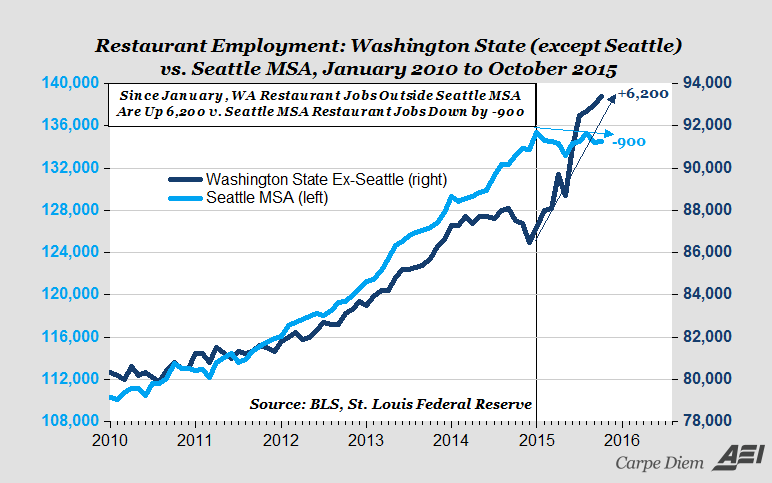
I'm sure it's just a coincidence that restaurant employment in Seattle stopped increasing just at the time Seattle enacted their $15 minimum wage.

Wednesday, August 19, 2015

The LA CIty Council's Minimum Wage Hike Is Also Working As Predicted

In September, 2014, Los Angeles City Council raised the minimum wage for hotel workers to $15.37. The wage went into effect in July, 2015, for hotels with 300 or more rooms, and will go into effect July, 2016 for 150-plus-room hotels.